
Research,
in its prime.

The collection
All 81 products →

UP-SEM-1
31 residues
GHK-Cu
Copper tripeptide-1
NA-Semax Amidate Liquid Spray
Atomized solution, 10 mL metered spray bottle
NAD+ Strips
Thirty dissolving strips
BPC-157 Tablets
15 residuesFour forms.


Kits
Products grouped for ordering. Each item keeps its own label, strength and price.
CJC-1295 / IpamorelinAOD-96045-Amino-1MQ
A secretagogue blend, the growth-hormone fragment AOD-9604, and 5-Amino-1MQ, a small-molecule NNMT inhibitor. Three vials.
- CJC-1295 / Ipamorelin5 mg / 5 mg
Was $95$76 - AOD-96045 mg
Was $92$73.60 - 5-Amino-1MQ50 mg
Was $82$65.60
Kit total
$215.20
3 items at their current prices. Each goes in your cart as its own line.
Each item in a kit is its own product with its own label. A kit is a convenience for ordering, not a protocol.
What a peptide is
SkipSmall chains.
Exact sequences.
The bond.
Two amino acids join through a peptide bond: the carboxyl group of one meets the amino group of the next, and a molecule of water is released. A chain has two ends, the amino end (N-terminus) and the carboxyl end (C-terminus).
The sequence, by weight.
BPC-157 is these fifteen, in this order. Each residue contributes to the chain’s mass. The calculated average molecular weight is the sum of the residue masses plus 18.02 g/mol for the two end groups: a reference value mass-spectrometry data can be compared with during identity analysis.
Why order matters.
Swap two of the fifteen and the weight does not change, but the molecule does. A total mass cannot tell them apart; tandem mass spectrometry breaks the chain into fragments, and the fragment pattern can reveal the order. The sequence, and any chemical modifications, define the molecule.
1,419.6g/mol · calculated average molecular weight
15 / 15 residues 1,401.6 + end groups 18.0 · PubChem lists 1,419.5; the difference reflects rounded mass values
| BPC-157 | GEPPPGKPADDAGLV | 1,419.6 |
|---|---|---|
| Two swapped | GEPPPGPKADDAGLV | 1,419.6 |
Same weight. Different molecule.
C62H98N16O22 · CAS 137525-51-0 · PubChem CID 9941957
A short history
- 1901 Emil Fischer and Ernest Fourneau make the first synthetic dipeptide, glycylglycine. Fischer’s work identifies the peptide bond that joins amino acids into chains.
- 1950s Frederick Sanger works out the complete amino-acid sequence of insulin, the first protein sequence known. Nobel Prize in Chemistry, 1958.
- 1963 Bruce Merrifield publishes solid-phase peptide synthesis: the chain is built one amino acid at a time on a resin bead. It is still how research peptides are made. Nobel Prize in Chemistry, 1984.
Sources: NHGRI, Peptide · Nobel Prize, Emil Fischer · Nobel Prize 1958 · Nobel Prize 1984 · PubChem, BPC-157
What the label tells you.

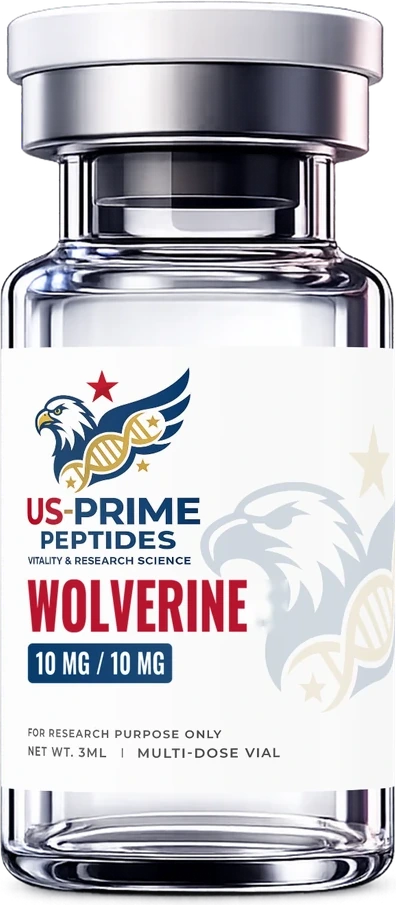
01The product
Named in full on every vial, in the same words as its page in the shop.
02The strength
The labeled amount, in milligrams. It is the same figure as the size you choose in the shop.
03Research use
For laboratory research only. Not for human consumption, and this site gives no instructions for use.
04The format
Lyophilized powder in a sealed vial.
Rendered from the product photograph. The label art is a provisional reconstruction.
Quality
What purity alone doesn’t tell you.
A purity figure tells only part of the story. Here are six questions laboratory testing can help answer.
- 01
Is it the right molecule?
Identity · Mass spectrometry
Measures the molecular weight and checks it against the compound on the label. A sample can be very pure and still be the wrong molecule.
- 02
How much of it is the peptide?
Purity · Reversed-phase HPLC
Separates the sample and reports the peptide as a share of everything the method detects, related fragments included.
- 03
Is the labeled amount there?
Net content · Content analysis
Compares the peptide in the vial with the amount on the label, allowing for the water and counter-ions every lyophilized peptide carries.
- 04
Any bacterial endotoxin?
Endotoxin · LAL assay
Screens for endotoxin, the heat-stable remains of bacteria. A purity figure does not show it.
- 05
Any microbial growth?
Sterility · Microbial testing
Checks the finished, sealed product for living microbial contamination.
- 06
Any heavy metals?
Heavy metals · ICP-MS
Screens for lead, arsenic, cadmium and mercury, which can carry over from raw materials or synthesis.
These are the methods and what each one measures, not results for any lot. A result belongs to one production lot and is recorded on that lot’s certificate. To ask for one, send the product and the lot number and we’ll check whether a matching certificate is available.
Who we are
Two partners.
One open price list.
US Prime Peptides was co-founded by two partners: one with a corporate career and a background in higher education; the other an entrepreneur with more than thirty years of business leadership. Every price is on the page and the same for everybody, and a question about an order goes to a person, not a form.
Questions before a first order
Who are these products for?
Everything on this site is sold for laboratory research use only. None of it is for human or veterinary use, and nothing here is medical advice. You must be 21 or older to order.
Do I need an account to order?
To check out, yes. Every price is visible without one and the cart is open to everyone. To order, create an account with your research details.
What does a certificate of analysis show?
Identity by mass spectrometry, purity by HPLC and the measured content of the vial, for one production lot. To get the certificate for your lot, email us the lot number from the vial label or packing slip.
How are products supplied?
Peptides are supplied as lyophilized (freeze-dried) powder in sealed vials. Sprays, dissolving strips and lab supplies are listed in their own categories, and each product page gives the form and storage conditions.
How fast do orders ship?
Orders are processed in 1-2 business days and ship with tracking. The tracking number is emailed when the label is created.
Do you ship internationally?
No. We ship to addresses in the United States only.
What if something arrives damaged or wrong?
Contact us within 7 days of delivery with your order number and photographs, and we will put it right.
Do you give instructions for use?
No. These are research materials for laboratory use only. This site gives no instructions for use, and we do not answer questions asking for them.